Saturday, May 26, 2012

Pavillon d'amour, Neuville-sur-Oise


One of the wonderful things about the Ile-de-France, the region surrounding Paris, is the density of ancient construction and—once beyond the grasp of the hodge-podge of rather depressing suburbs—the beauty and largely intact rural character of the land known as "the great crown." Neuville-sur-Oise is one of these ancient villages, grown around a feudal château, and its pride is one of the most perfect examples of the pavillon d'amour form, so perfect in fact that it negates this hoary architectural cliché of the clichéd age of la douceur de vivre. (Above, our watercolor portrait.)


The octagonally planned pavilion is a true belvedere, magisterially sited on a projecting cut-stone terrace overlooking the river Oise, the massive, canted and chamfered basement suggesting a ship's prow. The building is rather sedate until one considers the voluptuously over-scaled slate roof, another suggestive form evoking the voluminous, curving panniers of an ancien régime court dress.


The property had a brush with fame in the late 18th century, when in 1775 it was purchased by Count Mercy-Argenteau, the Austrian ambassador to the court of France and confidant and advisor to Marie-Antoinette. Though no documentation exists, it is believed that the pavilion was built earlier, in the mid 17th century, as it literally exudes the quiet sophistication of France's Augustinian Age.


The count brought artisans who had worked on the queen's own apartments at Versailles to embellish the château with fine furniture and exquisitely carved boiseries, and the mistress who undoubtedly inspired the pavilion's appellation was Rosalie Levasseur, who was—in yet another 18th-century cliché—a beautiful opera singer.


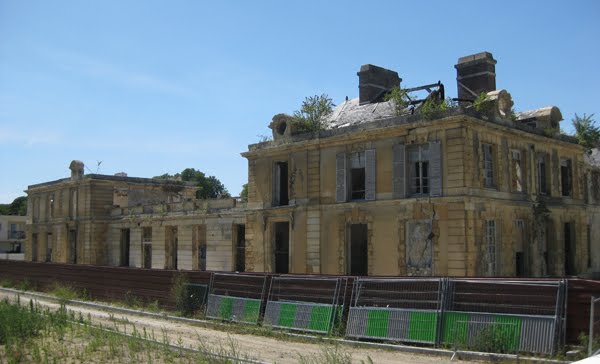
The pavilion was restored recently and has become the town's symbol and pride but the Château de Neuville has unfortunately not fared as well and is, inexplicably, a gaping wreck. It is always a mystery how such historic properties, relatively near Paris, can still today remain abandoned and in complete decrepitude.

I always imagine interminable lawsuits by feuding heirs stretching over generations and worthy of Bleak House. At least I prefer this to the idea of the owners allowing the property to rot beyond repair so that the land can be redeveloped, which is most often the case, as French landmark laws have no legal mechanism to force maintenance of most listed properties. However, in truth the still-handsome shell is thankfully slated to be saved and find new life as a retirement home.

Sunday, May 13, 2012

The Perrault Brothers and the Fate of Classicism


During the polemical ferment of France in the 1660s, Louis XIV's minister-factotum Colbert and the Perrault brothers, Charles and Claude, laid the intellectual foundations undergirding France’s political and cultural ascendancy. The Perraults played a central role in the adoption of classicism as the French state's de facto official architecture, and in turn classicism's transplantation from Italy to France had a decisive effect on the evolution of Western architecture, as a newly unhobbled France—with a population of over 20 million (greater than that of the rest of Europe combined) and an administration of rare ambition and matching competence—overtook Italy to finally claim its proper place as the first power of Europe.

Architecture had long been understood as the most tangible manifestation of the power and taste of princes, and so it is no surprise that it became intimately integrated with politics in a court where everything was considered to have political utility and a propagandistic dimension. However, the profession—long-neglected due to decades of civil unrest and the dearth of commissions during Louis XIV's long regency—had fallen into a state of disarray which demanded urgent, remedial attention.


This crisis was quickly redressed; in fact, it lasted less than a decade, and by the mid-1670s the negative impact of several initial architectural missteps (most notably Versailles itself) was effectively erased by the extraordinary efficacy and reach of the propaganda machine installed by Colbert and the cultural élite functioning under his direction, with Charles Perrault (above), also author of the Mother Goose nursery rhymes, acting as his chief architectural assitant. Architecture became so thoroughly enmeshed with the fabrication of the glory of the Sun King, and he in turn with the glory of France, that even today a halo of magnificence serves to protect this closed circle of eternal verities by its blinding influence.

One of the main elements of this hermetic structure is the doctor and architect Claude Perrault’s myth of a French classical tradition stretching back to the late fifteenth century, elaborated in the introduction to his translation of Vitruvius. Perrault's work was on the most basic level an attempt to appropriate Vitruvius—the personification of the Roman roots of the classical tradition—for France, as well as a means to create a classical pre-history to legitimize the adoption of Italian classicism as France's official state architecture.

Scouring France’s architectural history for native classicists and constructing an architectural Pantheon from them became a preoccupation of the Académie, as its members attempted to build a stair—however fragile—between French vernacular architecture and the state-sponsored classicism of the reign of Louis XIV. Tellingly, Perrault (below) whined in his introduction to Vitruvius that generations of Italian architects had conspiratorially hoarded their knowledge of classicism, and as proof he cited the dearth of Italian architectural treatises (frankly one has to laugh at his shamelessness).


All this was simply a desperate attempt to backfill an irreducible historical void, for there is a sharp break in French architecture between the hybrid classical/vernacular as practiced at mid-seventeenth century and the state-sponsored classicism that resulted from Bernini’s voyage to Paris in 1665. Indigenous French architecture, which Colbert took for granted as the most tangible symbol of royal power and authority save for exploits of war, could not be implicated as being unworthy of the role the royal administration had defined for it, and thus history had to be manipulated to bring the past into alignment with the needs of the present.


Classicism, that noble enterprise reborn with the Italian Renaissance, was adopted wholesale by France in the wake of Bernini’s passage. (The great Roman sculptor and architect had remarked while viewing Paris from the heights of Meudon that the city was like a carding comb: a forest of chimney pots unrelieved by any monument worthy of notice, ancient or modern, excepting its great gothic churches.) The cultural bureaucracy under Colbert's direction—which may as well be called the Perrault brothers' cabal—undertook a two-pronged effort to first efface Bernini's influence, primarily by vicious slanders directed by Charles, and secondly to erase any trace that France had ever known a time before classicism at all by Claude's fabrication of a made-to-order classical pre-history, anchored by a false legitimacy based on patently ridiculous claims to France’s inheritance of the legacy of Imperial Rome. It thus comes as no surprise that early in his reign, Louis XIV was more often represented as Caesar Augustus, Rome's great emperor, than he was as Apollo, god of illumination and the arts.


Perrault’s classical canon was simply pure propaganda (even the Spanish Habsburg's Escorial somehow got on the list) and served to obscure the Italian parentage of French classicism and thus held an important political dimension at the onset of an era of aggressive French adventurism in Europe. With the appropriation of Renaissance classicism by the cultural bureaucracy, absolutism supplanted humanism as the ideology underpinning architectural expression, and architecture became inextricably enmeshed with state policy and the manipulation of history to promote Louis XIV’s gloire—that is, the myth of the young, untried king’s power and omniscience, his generative force and semi-divine status.


Claude Perrault's Vitruvian project was instrumental in defining the theoretical boundaries and concerns ruling French classicism, but he also played a crucial role in facilitating its adoption by architects by devising a system for the practical application of classical principles, which he published as The Ordinance of the Five Columnar Orders According to the Methods of the Ancients in 1683. The work was an extraordinarily important manifesto couched as a practical “how-to“ guide to architectural composition, and its widespread adoption and numerous translations had a profound impact upon the course of classical architecture.

The treatise reflects Perrault’s dismissal of humanist principles and his promulgation of Descartian rationalism, with its view of a mechanistic universe. Perrault dismissed the quasi-mystical theoretical trappings which had enveloped the five columnar orders, but in so doing destroyed the fusion between meaning and proportion that imbued Renaissance classicism.

His underlying thesis was crucially incomplete, for Perrault concentrated solely upon codifying a single set of “perfect“ proportions for each of the five columnar orders (Tuscan, Doric, Ionic, Corinthian and Composite) while ignoring the larger, determinant question of the proportions of the building being ordered. Specifically, Perrault attempted to deduce a single formula for the internal relationships between the constituent elements of each of the orders, which he deduced by measuring a range of Ancient precedents and establishing a mathematical mean from them. To put it quite bluntly, Perrault invented cookie-cutter classicism, one size fits all.


In classicism, the building’s proportions were paramount and were ruled by the application of geometrical precepts derived from Greek harmonics and mathematics—namely, the Pythagorean geometrical progression of prime numbers and their relation to musical chords, elucidated in Plato’s Timaeus and encapsulated by the Harmonia mundi, the Music of the spheres (below). The proportions a classically trained architect selected to guide his design were comparable to the tonal key chosen by the composer of a musical work, and they in turn determined the choice and treatment of the columnar order that regulated and imposed hierarchy upon the composition.


The orders themselves, far from being static entities whose proportions could be scientifically deduced and quantified, were rather a kind of Platonic ideal, universal in theory but infinitely adaptable in their particulars. Thus they were a closed but elastic system that remained internally coherent, even though their constituent measures (the length of a column in relation to its diameter, for example) were logically varied in response to an architect’s intent and the proportional “key“ he employed.

Unaware or uninterested that a higher level of ordering principles was inextricably enmeshed in the humanist philosophy he dismissed, Perrault never properly addressed the question of the proportions of buildings. Though the French Académie pondered the question and several members also likened proportion to musical composition, these deliberations offered little more than vague platitudes—a feeble echo of the intellectual coherence and direct applicability of humanist principles.

The translation of classicism into a French idiom and its subsequent dissemination had far-reaching historical impact. The wide dissemination of Perrault’s treatise on the orders—which became a massive bestseller throughout Europe for over a century—was instrumental in pushing these principles into obscurity and depriving classicism of the greater part of its creative potential, an impoverishment compounded by the pedantic regimentation of the Académie. (One would be quite interested to know what these savants must have thought about Michelangelo's elongated yet massive, unfluted and volute-less Ionic/Doric columns—in pairs, no less—at the Laurentian Library in Florence, for example.)


Claude Perrault's conception was fully at odds with his subject, for classicism was an art whose fundamental aim was to transcribe Platonic ideals into stone and to express the poetry of the spheres with captured space. In essence, Perrault reduced a complex and nuanced art to the simplistic application of formula—a process of deracination that led to increasingly formulaic designs and that doubtless hastened classicism’s demise.

So shorn, apparently quite in ignorance, of its living, humanist roots, French classicism quickly devolved to the formulas employed by Jules-Hardouin-Mansart, the first and most successful student of Perrault's precepts. The compositional ease Perrault’s ideas afforded him found their ultimate fruit in the remarkable lack of scholarly interest in Hardouin-Mansart (the first monograph of his work was only published some five years ago), even though he was one of the most prolific architects in history and almost single-handedly defined (and designed) the architecture of the Age of Louis XIV. And this is because Hardouin-Mansart's designs are a simulacrum of classicism, a projection of gloire simplified and aggrandized to serve the needs of a monarch who in his maturity was less the leader of a kingdom than he was the figurehead of a vast state bureaucracy.

(Below, Hardouin-Mansart in action: the right-hand wing is the original Enveloppe of Versailles, at left his massive palace-by-the-yard northern addition; a nearly identical pendant was built to the south)


In turn, Hardouin-Mansart's stylistic hegemony and its limited repertoire would crowd out the experiments of the pioneering generations of French classicists and impose itself upon France, and Europe, for well over a century. Add to this the fundamental difference between the French and Italian conception of building—the Italian sculpts a cubic mass, while the Frenchman aligns rectilinear blocks in an accretive fashion—and the end result is Haussman’s Paris, its endless boulevards lined with uniformly handsome and nearly indistinguishable limestone apartment blocks. (Every Parisian has at least once left the Métro distracted and stood, hopelessly disoriented, wondering if he got off at the right stop.)


In the face of increasingly numbing standardization, architects abandoned the search for meaningful form and were seduced by the glittering attractions of novelty, engendering successive waves of historical pastiche in both the late eighteenth and nineteenth centuries (below, the Royal Pavilion at Brighton). Toward the end of both periods, committed classicists sought a corrective, reinvigorating classical vocabulary with new forms and a return to clarity and purified volumetrics.


Ultimately Perrault’s legacy is ambiguous. Turning to Italy in the seventeenth century, classicism also suffered decline as humanist culture waned, and Perrault’s principles, riding a swelling wave of French political, military and cultural influence, seem simply to have accelerated the inevitable. Perrault undoubtedly banalized classicism, but in so doing offered the key to its widespread adoption and thus played a critical role in fostering the extraordinary flowering of neoclassicism in eighteenth-century Europe.

Wednesday, May 2, 2012

Peleş Castle


Peleş Castle, like Johann Strauss' Blue Danube Waltz, is so perfect in its way, so zeitgeistig, that if it didn't already exist it would have to be created. Far more successfully than even the famed Neuschwanstein Castle built by Ludwig II of Bavaria, the Romanian alpine estate incarnates 19th century troubadour romanticism.


This post will be short on text and long on photos, simply because the property is so extraordinarily visually seductive—but its history is very short. (We highly recommend that you click on any photo to launch the enlarged photostream.) The castle was the brainchild of Carol I, Romania's first monarch, who discovered the achingly picturesque alpine scenery in 1866, then ordered purchase of 500 square miles to form the royal estate of Sinaia in 1872.


The king rejected three initial proposals as too simplistically historicist and lacking inspiration, but the scheme of German architect Johannes Schultz delighted him. Construction began in 1873 and the castle was inaugurated a decade later, though major elements, most notably the main tower (which rises 217 ft.), were added over later years until the estate reached its final form in 1914. An amusing pseudo-anachronism: Peleş was the first castle to be fully wired for electricity from the outset, with its own generator building.


This amazing confection, melding Tyrolian, Germanic and Italian Renaissance styles into a tour-de-force of historicizing scenography, features typically bombastic fin-de-siècle rooms encrusted with ornate woodwork, but like all follies, the interiors are simply an excuse for the exterior.

The castle, today a state-run museum, holds important collections of swords and armor and also of art, including most notably three works by the young Gustav Klimt.


Tuesday, April 24, 2012

The Pavilion San Rafael, Pasadena


For those of you living in the Los Angeles area, do not miss the opportunity to visit the Pavilion San Rafael and its lush gardens on Sunday, the 29th of April. This exceptional open house is organized through the Garden Conservancy; use the link to learn more and to acquire tickets, which will then give you complete directions to the property.

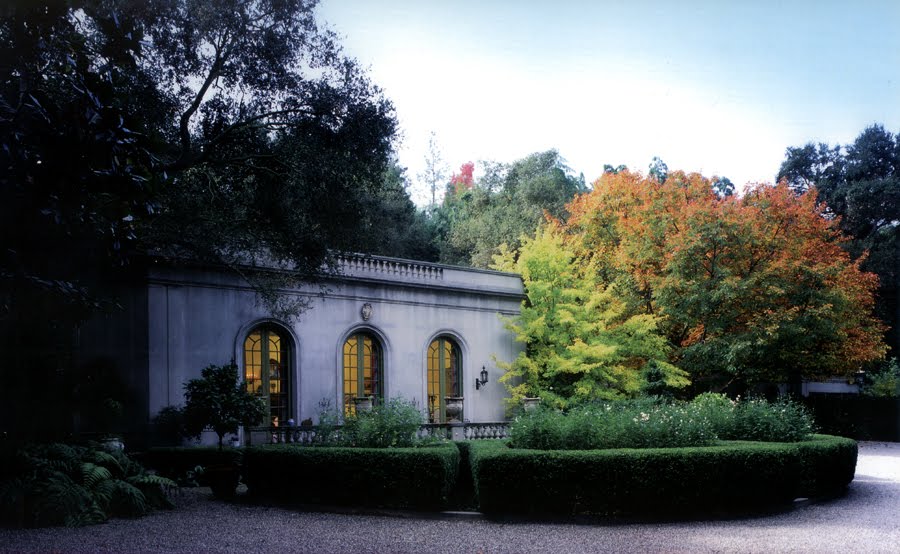
Above is our watercolor elevation of the pavilion, which today is a private residence but was originally built as a music pavilion in 1922 in a pure Italian High-Renaissance style for Raymond Gould, who made his fortune as the premier antiques dealer in Southern California in the teens and Roaring Twenties.


In 1914, Gould purchased 10 acres in Garvanza, also known as Highland Park, from the Campbell-Johnson family, the last owners of the 2500 acre Rancho San Rafael, which stretched from Pasadena and Highland Park to Glendale. The Campbell-Johnsons had built the Church of the Angels in 1899 just over the hill from the pavilion, modeled on a chapel in Dorking, Surrey. The church has wonderful Pre-Raphaelite stained-glass windows (below) and should not be missed if you do head off to San Rafael for the afternoon.


Gould had planned to build a Louis XIII-style château on the property but in the end lived in a neighboring Italianate villa designed by Reginald Johnson. The estate and its gardens soon became celebrated and were published in the influential and best-selling Gardens in America (1932) (below) and California Gardens (1928).


A founding member of the Los Angeles Philharmonic, Gould used the pavilion extensively, hosting cotillions, tea dances, concerts and debutante balls well into the Great Depression, when finally the financial burdens caught up with him and he retired from society. He and his sister lived on quietly at San Rafael until his death in 1945; his wake was held in the pavilion.

A Dupont heiress purchased the property from Gould's estate and lived there until her passing in 1957, when the estate was purchased by a developer who subdivided the grounds and drained the artificial lake that fronted the pavilion. The present owners have restored the pavilion and its surrounding gardens to their original glory. It is well worth the visit to see the only pure garden pavilion in the Pasadena area.

Thursday, April 19, 2012

The Porcelain Trianon


With war and building and his own gloire, flowers were one of Louis XIV’s abiding passions, and he indulged in them with characteristic immoderation. Year in and year out, the royal accounts note stupendous payments for flowering bulbs and plants, purchased by the millions from the world over. Colbert bore the brunt of this obsession, receiving notes like the following, sent before a visit to Trianon in the fall of 1673: “I expect to find many flowers, late or forced. My brother said that the garden isn’t as full as usual and that Le Bouteux (the head gardener) was holding things in reserve; I hope this is the reason. Look into it.“

Missives from the Sun King's glorious battlefronts invariably open with his most pressing concerns, orange trees and gardens. “Madame de Montespan has informed me that you have given an order to buy orange trees,“ begins a letter to Colbert from the camp at Gembloux during the spring campaign of 1675. Le Nôtre, who disliked flower gardens, nevertheless designed a flower parterre for Versailles at the royal behest—it was in fact among the first work undertaken there—and Saint-Simon tells of the court fleeing Trianon one fine spring day, overcome by the perfume of tuberose hanging in the still air.

(At top: our watercolor elevation of the main pavilion, and below: an engraving of the garden elevation, with the Château of Versailles seen distant in the upper left corner.)


As the sober neoclassical Enveloppe finally rose about the king’s gilded house of cards at Versailles, a little Orientalist fantasy also rose at Trianon, a village of such inconsequence that to raze it required less than a tenth of the sum subsequently spent for the compound’s entrance grille. The Porcelain Trianon stood a mere sixteen years and has been cloaked in legend since 1687, when renovation work began that eventually led to the compound’s destruction and replacement by the Marble, or Grand Trianon. The small compound was conceived as a royal pleasure ground, a retreat dedicated to indulging the senses: to tasting delicacies, smelling rare flowers, listening to the songs of exotic birds, savoring privacy, and of course to making love.

Its enduring renown is surely warranted: Trianon’s five pavilions, profusely decorated in a fantastic, Chinoiserie style and arranged about two oval forecourts paved with faience tile, stood amid parterres set out with flowering plants grown in clay pots—by the early 1690s over a million pots were in constant use—allowing gardeners to change the beds while the king dined, offering the surprise of a fresh color scheme for his afternoon promenade.


The original name of the Porcelain Trianon was "le pavillon de Flore," indicating that the impetus for the compound sprang from this passion, perhaps even more so than the king’s passion for the Marquise de Montespan, and the king's love of flowers would endure long after Olympe, the ingratiating name given her by La Fontaine, had in her turn taken up exile, piety and expiatory good works. The reasons that impelled the Porcelain Trianon into being are simple to surmise and follow a familiar pattern, driven as always by the king’s desire to recycle beloved elements of the early Versailles, amplifying them until they were distorted beyond recognition.

Construction of the Enveloppe entrained the loss of the king’s favorite spot in the park of Versailles, the Parterre des Fleurs, a flower garden on the south terrace of the Old Château. The Parterre was enclosed by a gilded balustrade lined by cypress and other evergreens, with tole vases holding orange trees, painted to resemble porcelain, set out at intervals against them, the intricate tracery of beds within “filled with a thousand sorts of flowers.“ (Below, our watercolor recreation of one of the painted-tole Chinoiserie vases at Trianon.)


The site for the new compound was fore-ordained: the vast Latin Cross of the Grand Canal was in the midst of being excavated and the Ménagerie, sited at the end of the Canal’s southern cross-arm, begged for a northern pendant. (In the twilight of the reign, Madame de Maintenon once blurted out, for no apparent reason, “Symmetry! I’ll die from symmetry!“) And finally the prospect of the greatly enlarged château, brimming with indolent courtiers, was undoubtedly judged by both participants as a looming impediment to the king's deepening involvement with Madame de Montespan (below).


In stylistic terms, the Trianon de Porcelaine, like the king's earliest campaign of gilded embellishments at Versailles, ultimately reflects the influence of the opulent interiors in which Louis XIV spent his youth. It was a crammed, intimate splendor, defined by the taste of his mother and Mazarin—a style that confounded the regal taste of the Spanish Habsburgs with the Cardinal’s fondness for the Italianate baroque. (Below: the family of Louis XIV by Jean Nocret. Few images exist of the interiors of the king's youth, but this painting gives us a good idea of what they would have been like.)


Likewise, this same touchstone of displaced parental affection, transmuted by the alchemy of the Sun King’s insatiable appetites—in 1670 a note from the king exhorted Colbert to “Press (the gardener) Le Bouteux and don’t let him lose a single moment“—engendered horticultural feats at Trianon repealing the natural law and that even today appear wantonly extravagant: jasmine and orange trees grown directly in the earth, protected in winter by demountable greenhouse structures, and parterres that were daily replanted with potted, greenhouse-forced flowers, even through the winter months.

As it was Europe’s first chinoiserie building, predating its earliest successor by well over a half-century, the Porcelain Trianon has gathered something of the miraculous about it—as if, as the court chronicler Félibien phrased it, the buildings had sprung up overnight after a spring rain. Built in a few months in the spring of 1671, the compound did indeed seem miraculous, though its remarkable, densely ornamented roofs were created by a large team of sculptors and ornamental painters in a second campaign that began two years later. One of the enduring myths concerning the compound is that its roofs were covered in porcelain tiles; however, our research shows that they were actually sculpted lead sheets painted to represent porcelain.

Scholars, faced with the horror vaccui of no clearly discernible precedent for a building manifestly without precedent, have long attempted to identify influences and tendencies that informed its design, the majority of them perfectly justified. However, what is most intriguing about the Porcelain Trianon is not so much that it was the first building of its kind, but that it was so thoroughly naïve. As architecture Trianon is nearly pure ornament, the embodiment and the proof of the idea that the fêtes in Versailles’ park inspired the bosquets and structures later erected there.

The compound’s architecture is pure scenography, a dazzling tour-de-force of baroque excess. Its Orientalist ornament, on close inspection, is purely French, executed with unlimited resources but without the rigor imparted by knowledge or the fire of inspired invention. As the president of the Société des Amis de Versailles remarked upon first viewing our watercolor reconstruction, "Oh la la! Ça c'est du kitsch!" One hears the voice of Madame de Montespan, inventor of the garden bosquet with the literally weeping willow, behind it all. (Below: an engraved view the courtyard side of the compound.)


Mostly this flatness was the fault of ignorance; in 1670, one simply had no idea what Chinese buildings looked like, let alone their materials, detailing and planning. Partly it was due to the terrible time constraints imposed by the relentlessly impatient king and his haughty, spoiled mistress, who saw to it that the pavilions flew up in a moment; and partly it was due to the architect Louis Le Vau’s health: he died in the midst of construction and while alive could not possibly have devoted the time and energy necessary to create anything more than a piece of stage decor, if indeed he was architect at all. (We believe the compound was a collective work and that the First Architect Le Vau, the First Painter Charles Le Brun and the royal gardener André Le Nôtre each had a hand in aspects of the design.)

Bizarrely, though the compound is traditionally attributed to him, Le Vau is mentioned but once in the relevant royal accounts, having supervised the destruction of the village of Trianon in 1663. Otherwise, like all the other royal buildings of the period, the Porcelain Trianon's architect is undocumented, which is an absurd state of affairs for France in the 1670s and indicates that a policy was in place demanding anonymity of royal architects, the better to propagate the freshly formed construct of the omnipotent and omniscient Sun King. The only contemporary attribution is that of the royal chronicler, Félibien, who claimed that Trianon’s architects were actually cupids and sprites; how utterly charming.

The Porcelain Trianon’s exoticism nonetheless had deeper referents, most importantly its intimation of the king’s boundless dominion over even the most distant empires, as well as his ability to suspend the seasons, but assessing Trianon as a serious piece of architecture is ultimately misleading and it should rather be judged on its own terms, as an amusing bauble of a building that pretended to little more. (Below: a table conserved at the Getty Center in Malibu almost certainly created for the compound.)


On this account, it was an unparalleled success, the first true folly of Louis XIV’s reign and the spiritual prototype for all chinoiserie pavilions that followed, just as the estate itself was a precursor of the English-inspired folly parks of the late eighteenth century, in which the world and its cultures were abstracted to furnish a nobleman’s amusement.

Félibien captured the charmed essence of Trianon, the ineffable atmosphere of indulgence that erased all criticism, when he called it “a little palace in an extraordinary style, and the perfect place to pass the time on a summer’s day.“ This is the very definition of a folly, encompassing pleasure, idleness, fantasy and amusement, and judging by these criteria the Trianon was a resounding triumph.

Wednesday, April 4, 2012

Louis XIV: patron, but no saint


[This is the first of an occasional series of posts considering aspects of the remarkable personality of Louis XIV, France's Sun King]

The king wants to go Saturday to Versailles, but God appears unwilling, because of the impossibility of readying the buildings to receive him, due to the prodigious mortality among the workmen. Cartloads of corpses are carried off nightly, as if from a charity hospital. The grim convoys are hidden so as not to terrify the worksite, and not to besmirch that “meritless favorite“—you know that quip about Versailles.

Madame de Sévigné, 12 October 1678


A disturbing undercurrent of obsession runs through the history of Louis XIV’s patronage of building. Madame de Sévigné’s clever chatter chillingly encapsulates the bemused disregard with which the court surveyed the Sun King’s building campaigns.


Cosseted in gilded salons, courtiers viewed schemes such as the tragic folly of attempting to divert the river Eure to Versailles—which killed thousands of military conscripts, squandered millions of livres upon a stillborn aqueduct to nowhere, and had as its only goal assuring that the fountains at Versailles could play at full force all the day long—as nothing more than an amusing diversion, a great gift of a joke that provided endless fodder for bons mots.

(Above, the failed Aqueduct of Maintenon, which today makes an undeniably picturesque landscape ornament.)

The court—composed of the ancient Nobility of the Sword and once a proud warrior class—had, by the midpoint of Louis XIV's reign, paled to snobbism, frivolity and pointlessness, emasculated by the king’s imperiousness and the glittering diversions he so cleverly dangled before it.

(Below, Louis XIV and the Dauphin before the shortlived Thetys Grotto at Versailles.)


When he wished to exercise it, Louis XIV held enormous power. To be brutally concise, the king—faced with splintered, ineffectual opposition—had almost free rein to act as he wished and was held in check mostly by his own conscience. This is the reason why his mother, Queen Anne of Austria, placed so much emphasis upon inculcating into the child-king the precepts of an honnêtte homme, a "good man," for without an ingrained moral compass the temptations of unchecked power could quickly bring a ruler and his nation to ruin.


This is also the reason why devout, intellectual clerics such as Bousseut and Fénelon (above) loomed so large in late 17th century French society: their topical sermons and the moral guidance they offered were effectively the only public criticism permitted of the monarch, the press being under complete governmental control. If anything was to be aired openly by a Frenchman not also a man of God, it was published, anonymously, in the Netherlands.


“This idol, gloire

By far the most amazing and damning indictment of the king came from the cleric Fénelon, and his open letter, addressed directly to Louis XIV, is all the more remarkable because he was also preceptor to the Dauphin—the king's eldest son and heir to the throne.

...while the people lack bread, you yourself lack solvency, and you refuse to acknowledge the extremity to which you are reduced. Since you have always been happy, you cannot conceive that you would ever cease to be so. You are afraid to open your eyes, afraid to be forced to relinquish a portion of your gloire. That gloire, which hardens your heart, is more dear to you than justice, than your own peace of mind, than the survival of your people, who daily perish from diseases borne of famine. And finally, it is more dear to you than your own eternal salvation, which is irreconcilable with this idol, gloire.


Fénelon's scorn was unprecedented, and it is amazing both he and his missive survived the king's reading. And he was absolutely right: the letters and memoires of ancien régime France are dotted with a leitmotif of anecdote as successive generations of aristocrats and ministers survey a desolate countryside from their carriages and remark upon starved peasants reduced to eating tree bark and grass.

The obsession with gloire—the king's radiant reputation—held by the king and the government, and in large part condoned by the court and society, was the end that permitted every means. Gloire was a throbbing, omnipresent concern at court; the distress of peasants was a distant, easily forgotten abstraction. And this was because gloire was the absract embodiment of the king and the object to which he ensured that the French state directed its energies. Its overriding importance drove Louis XIV to harness the government and in turn the French nation to supply every means to burnish and extend this charged symbol of greatness.

(Below, a detail of our watercolor of ironwork at Marly with the Sun King's cipher of Apollo in radiant glory.)


Louis XIV believed himself both monarch and first guardian of the monarchy, a concept formulated as "the double body of the king." Simply stated, the two kings were the living king and his eternal, inherited position of kingship. For Louis XIV, his gloire was more than a projection of his own prestige; it was the embodiment of the great history and traditions of the French monarchy, of which he was the personification and instrument.

The king worked ceaselessly to burnish and augment his gloire; it was the intellectual prism through which he considered his every policy move and in many ways it was the sum of his existence. Upon the incorporation of the Petite Académie, later the Académie des Inscriptions, in February 1663, the young king stated, “You may judge, gentlemen, the esteem in which I hold you, for I am entrusting you with the thing most precious in the world—my gloire. I am sure that you will produce marvels; for my part, I will attempt to furnish you with subject matter worthy to be dealt with by men as capable as yourselves.“


By strange paradox, for being so self-absorbed the king did not act from egotism. He was universally considered the most polite person that any of his contemporaries had ever encountered. This is borne out in the private letters and diaries of courtiers, in moments when they could drop their masks and recount the truth. It is a well-known fact that the king lost his temper in public but three times in his 72-year reign, and each occasion was incited by the insupportable boorishness or cowardice of his interlocuter. For his part, the king was usually aware when a line had been crossed; he once commented to Racine, “I would praise you more if you praised me less.“

To the king and the aristocracy, the overtaxed peasantry remained an abstraction, the childlike peuple for whom the monarch was their shepherd and benevolent ruler. Custom and situation fostered this remove; caught in the thrilling vortex of great affairs and inured by the theatrical display of vast wealth at court, the king and his entourage could easily justify the next great expense, since the last had done no appreciable harm, and so it was that an utterly superfluous château such as Clagny—estimated to have cost over three million livres, a sum equivalent to a third of the budget for the French navy—could be blithely commanded into being, then razed and rebuilt, for a mistress who herself was heiress to one of the richest noble families in the kingdom.


If Clagny (above, our watercolor elevation), for which even the king remarked "the expense is excessive," had been transmuted into a fleet, it likely would have turned the tide of the War of the League of Augsburg, forestalling or even reversing France’s decline during the second half of the king's reign, and thus forever altering European history. Granted, such historical shell games could be endlessly replayed, but as Madame de Montespan, the mistress in question, rightly observed when reproached for not showing remorse for having accidentally killed a man while riding in her carriage, it was only because her companions had happened to witness the death that they wept; men were run over constantly but they did not grieve for them.


Louis XIV was essentially a man of common sense and he well knew that we, posterity, ultimately would be more attracted to a good show—to grandiose, gilded monuments—than to "recompenses and good deeds."

Suffering is a constant of the human condition and so the human cost of the Sun King's obsessons has been long forgotten, and creations such as Versailles offer a glittering respite from the world as it is. Versailles endures. It will never lose its power to enchant, to transport us into forgetfulness.