Showing posts with label Louis XV. Show all posts

Saturday, January 18, 2014

La Maîtresse en Titre, an enduring French tradition


As the BBC is fond of calling him lately, "the man said to be the President of France" was—"perhaps"—infamously photographed in a crash helmet, leaving a purported love nest shared with a well-known actress while his chauffeur-driven moto waited at curb. The chauffeur of the Presidential Scooter, Closer magazine reported in an explosive seven-page exposé, also delivered fresh croissants in the mornings.

Hollande, a committed bachelor, has refused to explain himself, citing a longstanding French tradition of not delving too closely into the private lives of its public servants (with good reason), and the implicated actress has now sued Closer for libel, another longstanding French tradition for public figures who find themselves facing the unwelcome glare of unwanted publicity.


Meanwhile, in a dramatic development worthy of a soap-opera plot twist, the current Somewhat First Lady of France, Hollande's companion Valerie Trierweiler, has precipitously secluded herself in a Parisian hospital, suffering from "shock."

Unsurprisingly, President Hollande's abysmal poll numbers have rebounded by several percentage points, since en ce pays-ci respect is axiomatically accorded a virile leader, whatever his politics or abilities. With the latest revelation that he had managed to keep the alleged affair secret for over two years, including a hotly contested presidential campaign, the thinking goes that Hollande may indeed have hitherto unremarked managerial skills. And after all, Hollande presides over a country which actually has a name for the just-after-work hours so propitious for infidelity—l'heure bleue—and which also has a tradition of selecting iconic sex symbols such as Brigitte Bardot and Catherine Deneuve as models for Marianne, the official state muse.

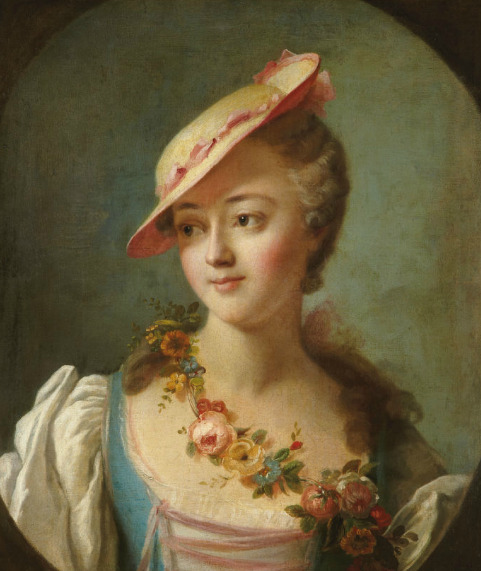
During the Ancien Régime, mistresses, most famously Madame de Pompadour, lover of Louis XV, were routinely ennobled and held a high official rank—Maîtresse en titre—and often wielded great sway over affairs of state. Madame de Pompadour not only reigned over patronage of the arts in the Rococo age but also influenced the choice of ministers and the strategy of the Seven Years' War. Her brother, the Marquis de Marigny, was appointed to the coveted post of Superintendent of Royal Buildings and so oversaw all government construction in the realm. A woman of considerable acumen, Pompadour created the infamous Parc aux Cerfs, an exclusive royal bordello in the town of Versailles, to satiate the king's voracious appetites and secure her position once her own charms had waned.


After her death, Madame du Barry, a nubile denizen of the Parc, ascended to la Pompadour's position but never her station. (Below, François Boucher's odalesque of Jeanne Bécu shortly before she became a countess.)


But the quintessential concubine was Madame de Montespan, l'Athenée—well-born, clever, scheming, haughty and ambitious—who had bewitched Louis XIV in his early middle age (quite literally and scandalously with a love philtre procured from a satanist who also brewed very efficient poisons, but that is another story). The king sired four illegitimate children with her, all later ennobled, one of whom was later exiled as an insurrectionist. While in royal favor, "La Montespan" reigned as de facto queen, with a suite of rooms at Versailles that eclipsed those of the actual queen, the homely and devout Infanta, Maria Theresa.


Louis XIV's German sister-in-law, la Princesse Palatine, in her posthumous letters reported that during the Dutch Wars, Louis XIV dutifully spent much of each campaign season at the front, presiding over war councils and generally being deferred to, though “he took quite a long time dressing; he had his moustache curled and sometimes spent half an hour before the mirror arranging it with wax.“ (With victory in sight, the undertaking degenerated into showmanship and farce, as when the king invited his decorator and gardener to tour the siege of Cambrai in 1677, instructing his minister Colbert to pay Le Brun and Le Nôtre each 1500 livres for their pains.)


And it was at Cambrai—a jump-the-shark moment if ever there was one—that the king joined his armies with the queen and two mistresses in tow like a band of gypsy camp followers. German mercenaries heckled Madame de Montespan as they marched in revue, whistling and shouting, “Konigs Hure!" At dinner that evening, the king inquired how she had liked the maneuvers and Montespan replied, “Perfectly lovely, only I find the Germans far too naïve for insisting upon calling everything by its proper name.“

It was also understood that Madame de Maintenon, a late and pivotal mistress of Louis XIV, controlled state affairs by forcing all ministers and petitioners to pass through the gauntlet of her appartements at Versailles if they hoped to gain access to the king. She was known at court as "Madame de Maintenant" (Madame Now), and had doubtless married the king privately, though this was never officially acknowledged.


Like just about everything else during the Ancien Régime, the changing of the guard was also handled with aplomb. In one of those almost-too-good-to-be-true moments of history which are nonetheless true, Madame de Montespan, on her way out, and Madame de Maintenon, on her way in, first met on a staircase in Versailles. Madame de Maintenon was ascending and Madame de Montespan descending. The former remarked, "I see that you are going down, Madame, while I am going up."

Upon her fall, which was both spectacular and precipitous, la Montespan exiled herself to a nunnery and occupied herself with expiatory good works, in keeping with another longstanding tradition of discarded royal mistresses, as hospitals in that century were where the destitute were brought to die.

Plus ça change, plus c'est la même chose.

Sunday, October 16, 2011

A Beautiful Fall


In this autumn of our discontent, when today's Washington Post lead headline reads "United in anger, 'Occupy' protests go global," it seems a fitting moment to discuss the garden architecture of pre-revolutionary France. You may smile—indeed we hope you do—but also do recognize that the two subjects are far from being non sequiturs and in fact the garden buildings erected for the aristocracy during the reign of Louis XVI foreshadow later events as presciently as any scandals or political machinations of the period.

Lest we forget, in 1663 Colbert had advised the young Louis XIV (well before he had done anything of serious note) that nothing would increase a monarch's reputation more than glorious exploits in war and building impressive monuments. War and building were uttered in the same breath and indeed were twin pillars of the Sun King's reign: architecture held the highest strategic importance and building was a tool second only to war in the state's policy arsenal. (Below: Versailles, what Louis XIV built to amuse himself.)


As Louis XIV's legacy played out, his successor, Louis XV, naturally timid and reclusive, built intimate pavilions rather than palaces, the pendulum swinging in the mid 18th century to its opposite apogee. In part this was because his predecessor had bankrupted France with his wars and his monuments—to which Louis XV was obliged to add his own, without ever undertaking the necessary reforms to support them. The perpetual, unstated bankruptcy of the state, thrown to a crisis pitch after the disaster of the Seven Years' War, would mean that bills simply were not paid—not that expenses were seriously curtailed. Royal architects, clerks and draftsmen worked years without pay; gardeners starved and finally deserted; maintenance was deferred and broken windows were replaced by oiled paper. The king would most famously say, "Après moi le déluge," and he could not have been more correct, or more cynical. (Below: the Petit Trianon, what Louis XV built to amuse himself.)


Louis XVI, even more timid and maladroit than his predecessor, built next to nothing. (The Sun King's great legacy and burden had run to ground, perfectly illustrating the old adage of "Clogs to clogs in three generations," but in this instance the fortune built and squandered by the Bourbons was that of Europe's richest and most populous nation.) It was Louis XVI's queen, Marie-Antoinette, who commissioned nearly all royal building during the reign, to the extent that she provoked scandal by creating the position of first architect to the queen. (Below: the Marlborough Tower at the hameau, what Louis XVI's wife built to amuse herself while the king amused himself with clockworks.)


The manifest decadence of her elaborate farmers' hamlet at Trianon, le hameau, whose rustic stucco walls were cracked and aged by artisans, provoked the scorn and ire of her subjects, who rightly saw a queen playing milkmaid with Sevres jugs at Versailles while there were bread riots in Paris as contempt for their plight. Likewise, the hameau was taken as certain proof that consideration of the people's opinion did not even cross their rulers' minds; even hypocrisy would have been preferred to having simply been forgotten—or in the queen's case, to having never entered her consciousness at all. It is safe to say that the hameau, along with the infamous diamond necklace scandal, cost the queen her head exactly 218 years ago today. (Below: a Sevres milk bowl and stand, commissioned by Marie-Antoinette for the dairy at Rambouillet.)


More broadly, though, the last decade before the revolution witnesses the French aristocracy—or more accurately that portion of it attached to the court—building ever more elaborate gardens and shoehorning onto them ever more and ever more exotic follies. The competition was fierce and a desperate rage for exoticism gripped the players. Here we quote from our first book, Pleasure Pavilions and Follies:

These late follies offered a boundless repertoire of imagery: pagodas evoked the Orient, innumerable thatched huts hearkened to Edenic idylls, farm villages presented a supremely false vision of peasant life, temples and rotundas echoed the Ancients. All the world and all its cultures were plundered to provide adornments for a nobleman's garden, leading the prince de Ligne to bemoan in 1781 that "Chinese buildings reek of the boulevards and sideshow fairs," and that "Gothic houses, too, are becoming too common." He proposed instead the hitherto untapped ornamental possibilities of Moldavian huts and allowed that Arab and Turkish styles had not yet been exhausted.

(Below: the mosque at Armainvilliers, built for the princesse de Lamballe, intimate of the queen, by an indulgent father who also happened to be the richest man in France.)


De Ligne, another intimate of the queen and someone for whom the oxymoron "profoundly frivolous" could have been coined, had captured the zeitgeist perfectly; in fact, he incarnated it, bragging that he ordered all his follies and suits on credit.

This decadence also expressed itself financially, as it always does. De Ligne, like the baron de Saint-James, the duc de Choiseul and others, bankrupted himself on his gardens, just as, in the late 1780s, the French state was borrowing against projected tax receipts decades hence. If one stops to ponder, it is simply extraordinary that someone like the duc de Choiseul, who ruled France for over a decade as de facto Prime Minister for Louis XV, could bankrupt himself at all, and that he had done so upon a garden. All these élites throwing all their money into gardens, their progeny be damned—quite the spectacle. And what is a garden in the end but a useless fantasy, a cipher for Eden, for paradise, an escape?

(Below: the Lake Pagoda at the Folie Saint-James, which, as its name indicates, stood on wooden pilings sunk into an artificial lake, and was reached by a fretwork Chinoiserie skiff.)


These bankruptcies showed great determination, since the élite had abandoned both traditional stone construction and the cheaper but inferior method of rubble-fill and stucco as well. They had also abandoned the formal French garden of Le Nôtre for Anglo-Chinese folly gardens and also for Masonic gardens, since they had also abandoned the Church and freemasonry was rampant. They built for novelty and effect, not permanence. They erected literally hundreds of flimsy stick-and-lathe structures, crass bastardizations of the world's native cultures, from pagodas to teepees, most of which would not survive the next decade let alone the next century. Or they squandered immense sums on absurdities such as an enormous boulder destined for a grotto in the baron de Saint-James' garden—a stone that required 40 draft horses to drag from the forest of Fontainebleau to Neuilly. (Louis XVI came upon the Sisyphean scene while hunting and, flabbergasted, inquired about the owner, and thereafter referred to Saint-James—who died a pauper in the Bastille—as "the man with the rock.")


Fake tombs and real hermits were also much in vogue. The princesse de Monaco, mistress of the prince de Condé, commissioned an entire "Valley of the Tombs" for her estate of Betz and also kept a hermit, who was forbidden to speak, to animate her thatch-roofed ermitage. The marquis de Girardin also kept a hermit, whose ermitage was praised in a guide for its Spartan furnishings, and moreover the marquis had the great good fortune that his most famous guest, Jean-Jacques Rousseau, died while visiting Ermenonville, permitting him to inter the great writer in a pseudo-antique sarcophagus on a small island in the lake fronting his château, making Rousseau's corpse the ultimate in morbid garden ornaments-cum-prizes. (Above: Girardin's Spartan-chic ermitage at Ermenonville; below: Rousseau's tomb.)


The list of instances of wretched excess and breathtaking decadence, of abandoned traditions and frivolous dilettantism, of willful blindness and stunning naïveté, of callous inhumanity and ostentatious self-gratification could go on for volumes, and this is only history as told through garden follies. The revolution, when it came, swept over France with unparalleled fury; hideous vengeance was exacted and it required well over a century for the country to settle finally into stable democratic rule. We'll leave it at that.

Friday, August 19, 2011

Versailles, off the beaten track


We've published two books dealing with Versailles (links here) and have always approached the château as an architectural and historical enigma—what was Louis XIV really up to when he turned the obscure hunting pavilion of his father into the seat of the French state, and who really built the "Envelope" that is the basis of that vast palace?

These are questions not easily answered —after all, they required two books—and though they go to the heart of "why" Versailles exists, they are certainly too involved for a blog post in mid-August. Especially when it finally feels like mid-August, even in Paris, and so we wanted to share a much more approachable side of Versailles—some views of the château that the public never sees: places off the beaten track that we photographed some years ago now. But then Versailles is eternal; what are a few years when confronted with a few centuries?


Above are some views taken from the apartment of Madame de Pompadour, the lover of Louis XV and "mistress of the arts." As you can see, her rooms were beneath the eaves of the château, overlooking the Marble Court, and were (unsurprisingly) directly above the king's own. Needless to say, the views outside were infinitely more interesting than the apartment itself.

Louis XV, "the gracefully bored," was the inverse of all that his predecessor stood for. Intensely private, he suffered mightily inhabiting the monstrous propaganda machine that Louis XIV had fashioned for himself. After his official coucher, where he carried out the semi-public pretense of going to sleep in the Sun King's bedroom, he then took a little lift to Madame de Pompadour's rooms, where he dined and entertained into the wee hours.

The Mercure de France (the Ancien Régime's Pravda), daily reported the hour of king's levée (awakening), which was also (in the ridiculously hermetic pretense of absolutism) the time at which the sun officially rose. Under Louis XV, the sun rarely rose in France before noon, and often after 1:00 in the afternoon. He was renowned at court for preparing his own morning coffee and for unerringly decapitating his soft-boiled egg with a single, deft knife-stroke.


This is also the same view, under more threatening skies, that Louis XV had from his own apartments when he watched Madame de Pompadour's coffin leave Versailles for a funeral that he could not, as king, attend.

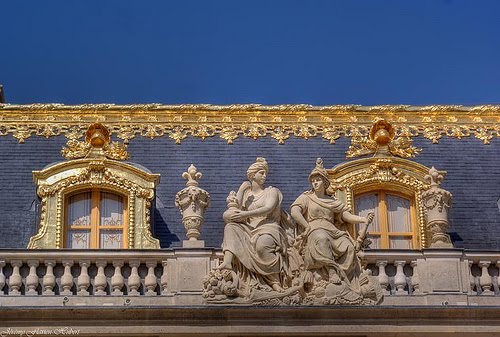
In 2009, the leadwork ornaments on these roofs were regilded for the first time since the Revolution. Believe it or not, the question of whether to regild the Marble Court's roof ornaments was one which ultimately concerned the highest levels of the French state and which took generations to resolve. We first heard of the debate in the 1980s; the work was finally carried out in 2009, with enormous trepidation.


For the French political class, spending money (even private donations) to gild the roofs of Versailles was akin to the US Congress authorizing a museum of the Confederacy on the Washington Mall: i.e., political suicide. The project was finally justified as part of renovations necessitated by a massive storm that occurred in 2000, nine years before the actual work began, and in the end the roofs of gold caused none of the leftist backlash the right so dreaded. Of course, this is now cited to invoke carte blanche by those who wish to return the château to its state at the death of Louis XIV in 1715, and who frankly would just as well clone the Sun King from strands of hair found in his wigs and place him on (a contemporary, though nonetheless faithful restitution of) the royal throne—if only for the sake of historical accuracy.

However, even history cannot excuse bad taste. Sir Christopehr Wren visited Versailles in the mid-1660s, when Louis XIV, then in his early twenties, had renovated the obscure hunting lodge of his father, turning it into a cosseted weekend retreat for lovers and select friends, long before he thought to aggrandize it so unexpectedly. Today, Wren's judgment of that early Versailles would be summed up as "effiminate bling." As he wrote to a friend, "The Palace, or if you please, Cabinet of Versailles call'd me twice to view it. The mixture of brick, stone, blue tile and gold make it look like a rich livery; not an inch within but is crowded with little curiosities of ornamanents... Works of filigrand, and little knacks are in great vogue, but building certainly ought to have the attribute of the eternal..."

Wren was not alone among world-famous architects in holding this opinion; in 1666 Bernini also visited France and remarked that young Louis XIV was inordinately fond of gaudy knick-knacks (besides Versailles, he cited jonquils massed in crystal vases at the Tuileries) that would horrify Roman matrons.


Here we are looking at one of the interior courtyards, the cour des cerfs or "courtyard of the deer," which is named after its deer-head sculptures (and is not to be confused with the infamous bordello of the same name run for Louis XV's pleasure in the town of Versailles). Madame du Barry (the last mistress of Louis XV, and by all accounts the most beautiful and agile) had her apartments here, and was discovered there.


These empty, beautifully gilded, and low-ceilinged rooms on the same floor once belonged to Marie Antoinette and were also where she began her famous, panicked flight from the château to the grotto in the gardens of Trianon, when she learned that the people of Paris were marching to Versailles on 5 October 1789, inciting the French Revolution. They are in the pure Louis XVI style, named after her husband, who had nothing to do with anything involving taste, preferring instead to tinker with clockworks in his private rooms, which in its way does indeed explain much about his reign and particularly its end.

Tuesday, May 17, 2011

Hidden in Plain Sight

This small limestone pavilion, of truly exceptional beauty, was built in the mid-18th century at the entrance to the Maison royale de Saint-Louis, known simply as Saint-Cyr, the vast convent school that stood a bare stone's throw from Versailles. Louis XIV established St-Cyr in 1684 as a pension to educate impoverished aristocratic girls at the behest of Madame de Maintenon, his pious morganatic wife, and the imposing complex was the work of Jules Hardouin-Mansart, the Sun King's ubiquitous First Architect.

Louis XV, true to form, held not the slightest interest in Saint-Cyr; though he was its patron and paid its bills and galloped past its gates on hunts literally hundreds of times over the decades, he never once bothered to visit the school and refused to enroll any of his daughters there. Nonetheless, he did commission the Pavillon des Archives; and though records have been lost, the pavilion's outstanding quality and distinctive style indicates that it was quite probably designed by his First Architect, Ange-Jacques Gabriel—the greatest French architect of the mid-eighteenth century and author of the Petit Trianon and the Place de la Concorde.

In 1808, Napoléon, also true to form, transformed St-Cyr into a military academy. Heavily damaged in World War II, the complex was restored by order of Charles De Gaulle and still today houses a military academy. Fortunately, the Archives Pavilion survived virtually unscathed from these attacks, though its interiors suffered at the hands of ruthless, fluorescent-lit postwar functionalism.


There is profound truth in the real-estate agent's mantra of "Location, location, location." Though it is a perfect jewel—the apex of the pavillon de plaisance form and the distillation of French neoclassicism—nevertheless the pavilion remains virtually unknown and has rarely been published in the architectural literature, and even then as a footnote. Had it been erected within Versailles' walls rather than in St-Cyr's shadow, the pavilion would today be mentioned in the same breath as Gabriel's masterwork, the Petit Trianon; instead it stands overlooked and anonymous, mere yards from the main road linking the towns of St-Cyr and Versailles.

Wednesday, February 16, 2011

Guard Pavilions


One of the most distinctive elements of the French château are the paired guard pavilions (guérites) that flank the entry to the forecourt and that announce and distill the estate's architectural style. We have become quite fond of these small architectural jewels and have been searching for and painting a number of them in the past few years.

Until well into the 18th century, the rectangular block created by the château and its forecourt, and occasionally the garden parterre also, was often delimited by a wet or dry moat—an esthetic holdover from the middle ages when châteaux were actually châteaux forts, or fortified castles. Even after moats fell out of fashion, the forecourt was still enclosed by high stone walls or ironwork grilles that abutted the guérites for privacy and security.

Even Louis XV's Petit Trianon, safely ensconced in the Great Park of Versailles, held to these traditions, though its architect Gabriel reduced the guard pavilions to dollhouse-like miniatures barely large enough for a sentry to stand in. Others, such as those built at Chanteloup for the king's disgraced First Minister, the duc de Choiseul, are small cubic pavilions set far from the château itself. (Below, top: Petit Trianon, bottom: Chanteloup)

At Blérancourt and Chantilly, both dating from the 17th century and sharing the same distinctive slate roofs, the pavilions border moats, dry and wet respectively. Quite clearly, guérites also lead charmed lives, as many of them—including those at Chanteloup and Blérancourt pictured here—survived the destruction and parceling of their estates after the French Revolution.
(Below, top: Blérancourt, bottom: Chantilly, shown also in the lead photograph)

A personal favorite are the rococco guérites at Champlâtreux, with their overscaled oculus windows set in gracefully sweeping mansard roofs.