Showing posts with label French Revolution. Show all posts

Friday, December 6, 2013

Aux barricades, comrades!
France toys with its next revolution


Mon dieu! Where to begin? the French government, in a bout of historical amnesia, has decided to erect a nationwide network of electronic "éco-tax" barriers straddling its major highways (which have been privatized into corporate-owned toll-roads, but that is another matter) to collect an environmental tax upon the country's long-distance truckers.


Well, apparently this was the tax too far, the impot that broke the camel's back, and Brittany—that poor, agrarian and fiercely self-aware region that French nationalism never fully managed to tame—has gone into open revolt. Red Phrygian caps, or "red bonnets," symbol of the French revolution of 1789, have become all the rage, sported by enraged citoyens who gather to wave the Breton flag and to set fire to these newly erected electronic tax barriers, while the nation's truckers have organized to block the country's major vehicular arteries for the last several weekends.


Open revolt. That, in a nutshell, is what is currently brewing en ce pays-ci, which coincides with record levels of popular discontent with the government and a record-low approval rate for the Président de la République, François Hollande. Hollande has plumbed the lowest depths of approval (and conversely the apex of popular disapproval), reaching 16% overall approval in the latest national polling—just nine percentage points ahead of the US Congress.

In an unprecedented display of public discontent, Hollande was publicly booed and heckled while observing solemn Armistice celebrations at the base of the Arc de triomphe this past November 11. For the moment, civil disobediance and organized arson are reserved for weekends and national holidays, in the French tradition of protest as wholesome family entertainment. However, all this could change with further incitement, leading to an escalation to public strikes—another French tradition that even the leader of the nation's most leftist union has publicly disavowed, fearing to become the spark that sets off a mood that is "explosive all over."


Meanwhile, the country's préfets, akin to county executives, sent a confidential, leaked memo to the Elysée that stated in the starkest of terms that conditions in France are a "tinderbox," that the populace has never been more resentful of the unrelenting onslaught of increasing taxes and stagnating incomes, and that the government had better take heed of, and gingerly diffuse, this volatile situation or face a "fronde sociale," or popular revolt.

So, what did the government do? Why, it also decided to increase the national sales tax, or TVA, come the new year. Bonne année!  Only problem, fully 81% of French citizens find the current tax system unjust and want the country's finances completely revamped.

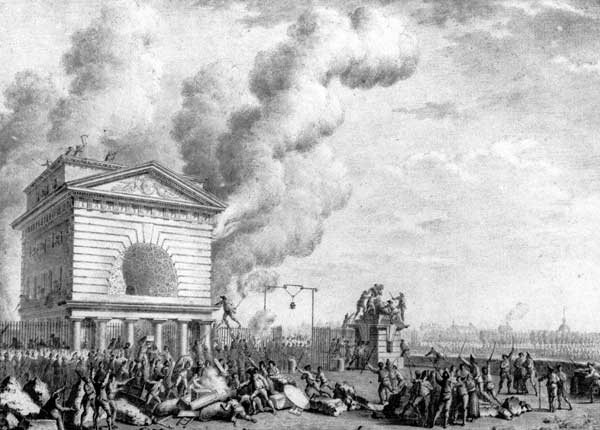
A few tidbits of history, to put all this in perspective. The last time France had a revolution, in 1789, it was incited by increasingly onerous taxation by a deeply indebted government, culminating with the construction of a physical Berlin wall of tax barriers about Paris, imprisoning the city's populace (we even blogged about it, here).


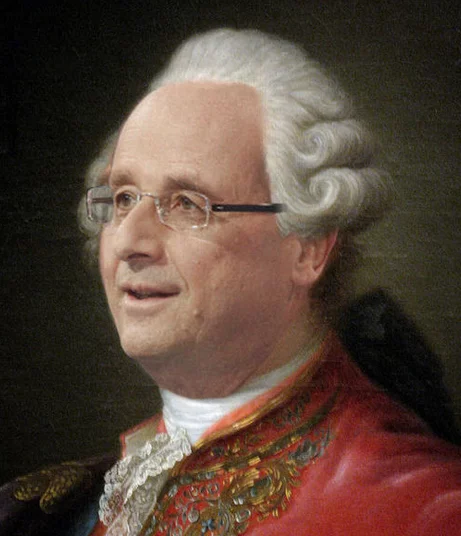
Also note the uncanny resemblance of President Hollande to Louis XVI, and the uncanny resemblance of his policies to those of the late, beheaded monarch: blind allegiance to the status quo in the face of increasing popular discontent during a prolonged period of deepening economic adversity. One should also remark that Hollande shows none of the creativity or intestinal fortitude necessary to reddress the mounting crisis of confidence in the competence and direction of the French government itself, to say nothing of a fundamantal realignment, overwhelmingly demanded by the citizenry, of its implacably oppressive tax structure. 


Today, the New York Times reports that the populist, far-right Front National is the most popular political party in France, with the Socialist Party of Hollande trailing badly. You do not need to be an oracle or a political pundit to divine that the present moment is about the absolute worst time for the government to re-erect a modern version of the tax barriers that incited the French Revolution. 

Willful amnesia, and déjà vu all over again.

Tuesday, March 13, 2012

Ledoux & the All-Seeing Eye


It is frankly a miracle—or at least a testament to his miraculous persuasive skills—that the architect Claude Nicolas Ledoux survived the French Revolution. Indeed, he was the Albert Speer of his day.

In his youthful prime, Ledoux (1736-1806) was architect to Louis XV’s mistress (and former prostitute), Madame Du Barry, to numerous exceedingly wealthy Parisian clients, and most incriminatingly to the detested royal tax collectors, or Ferme Générale, for whom in the late 1780s he built the Berlin Wall of its time, an impenetrable barrier that encircled Paris, erected to ensure that the taxmen received every last sous of their octrois—the internal duty on all goods entering or leaving Paris. (Below, elevations of the various customs pavilions Ledoux designed, all of them twinned, and many still standing in Paris today.)


His notorious "Wall of the Farmers-General," sixty grandiose tax-collection offices ringing Paris and linked by barricades, was denounced as a "monument to enslavement and despotism" and "the bastions of taxation metamorphosed into columned palaces," and was itself a major cause and symbol of the Revolution.


Ledoux, object of scandal and vitriol, was relieved of his duties in 1787, three years before the Revolution, and even Jacques Necker, Louis XVI’s newly appointed finance minister, disavowed the entire enterprise. Nonetheless, Ledoux escaped the guillotine and spent his final years burnishing his own reputation and redrawing his life’s work—achieving, with the advent of Postmodernism in the late 20th century, a fame only he himself envisioned.

The Royal Saltworks at Arc-et-Senans

Ledoux's most famous work is today hailed as a visionary utopian scheme but is actually a direct outgrowth of his early work as a provincial architect-engineer. The impetus for a saltworks at Arc-et-Senans was due to a rich and easily worked seam of halite (rock salt), the proximity of inland waterways for transport and the nearby forest of Chaux, which provided the wood necessary to fuel the boilers to process the mineral salts.

The speculative scheme was conceived in 1773 by the powerful Ferme Générale, or association of tax collectors, who assured Louis XV's support and provided funding through the gabelle, a general tax on this essential commodity. His overweening confidence (he was after all an architect) led Ledoux to begin his first design before either receiving the king's approval or knowing the actual site selected.


Ledoux remarked that the plan of the saltworks "should be as pure as that described by the sun along its transit." (An interesting simile, coming as it does from a freemason, and his ideal plan, above, is the All-Seeing Eye incarnate.) Construction began in 1775 and operations began three years later. However, the venture never returned the profits its investors envisioned; production rarely rose above half of the projected volume and easily harvested tidal salt deeply undercut processed rock salt in price.

Nonetheless, the tax farmers were satisfied with Ledoux's work and, in a career move that nearly cost him his life, he was named official architect of the Ferme Générale, designing their Paris headquarters and overseeing the massive—and massively unpopular—project to encircle Paris with a tax barrier.

Ledoux was imprisoned during the Revolution and owed his life to the intercession of the painter David—who had been far more clever, befriending Robspierre and becoming a revolutionary leader, though he too owed his wealth to the aristocracy and particularly the patronage of the Ferme Générale.

Utterly disgraced in post-revolutionary France, Ledoux would never again work as an architect and devoted the remainder of his life to aggrandizing his work with a view to publication and vindication. His isolation fostered irrational but truly visionary schemes: the demi-lune plan of Arc-et-Senans, though a proven financial failure, was enlarged to a full circle, at least on paper, and about it Ledoux conceived the radially planned (think the Sun's illuminating rays), utopian worker's town of Chaux, with its remarkable collection of geometrically audacious (and masonically inspired) structures. If somehow the visual symbolism escaped notice, Ledoux made sure one understood his point by calling Chaux "a gathering of brothers."

Below, the Director's House, its pediment pierced by an oculus, creating the All-Seeing Eye of Horus.


Not so far different than...


... or...
... or...
... or...

... or even...


... or her occasional partner in crime...


One could go on indefinitely but by now we're sure you've gotten the idea. To quote the Grateful Dead, "What a long, strange trip it's been."

Early in his career Ledoux had—obviously—become a freemason, since in the late 18th century the majority of the French aristocracy concentrated at Versailles and in and about Paris had abandoned Catholicism for this occult brotherhood and the ambitious young architect rightly saw membership as a sure path to success. Even today, Le Point and l'Express, France's Time and Newsweek, devote at least one cover-story per year to freemasonry's enduing influence in French affairs:


Unsurprisingly then, Ledoux's architecture is permeated with Masonic symbolism. The pediment of the Director's Storehouse at Arc-et-Senans is also pierced by an oculus, the All-Seeing Eye of Horus (above, our elevational watercolor), and beyond his insistence on pyramidal forms and Egyptian-inspired proportions and massing, Ledoux's prediliction for the Palladian window motif evokes as much the columns Jachin and Boaz as it does the Venetian master, especially when typically allied with robust, crisply rectilinear rustication which, depending on its use, recalls either the checkered floor or the dressed ashlar. Ledoux's project for the Overseer's House at Chaux (how appropriate!) is the Eye of Horus in 3-D form (below). And on and on he went... Quite the obsession, truth be told.


Ledoux published the first volume of his ceaselessly redacted life's work in 1804, two years before his death. Though the text was dismissed as the ramblings of a madman, the plates of ideal cities and his radical vision of monumental architecture were widely admired by contemporaries.

Later generations simply ignored him, and it was not until the 20th century that he would be rediscovered as an architectural visionary by, successively, the Cubists, Surrealists and Postmodernists, and his work finally achieved the recognition and influence he sought. (Below, a section through the project for the Cemetery at Chaux, yet another and certainly the most literal of Ledoux's All-Seeing Eyes, its oculus/pupil fixed on the heavens.)


In 1926, some of the main buildings of Arc-et-Senans were dynamited, doubtless by an infuriated anti-mason, and were subsequently rebuilt. In 1982 the complex was designated a Unesco World Heritage Site.

Sunday, October 16, 2011

A Beautiful Fall


In this autumn of our discontent, when today's Washington Post lead headline reads "United in anger, 'Occupy' protests go global," it seems a fitting moment to discuss the garden architecture of pre-revolutionary France. You may smile—indeed we hope you do—but also do recognize that the two subjects are far from being non sequiturs and in fact the garden buildings erected for the aristocracy during the reign of Louis XVI foreshadow later events as presciently as any scandals or political machinations of the period.

Lest we forget, in 1663 Colbert had advised the young Louis XIV (well before he had done anything of serious note) that nothing would increase a monarch's reputation more than glorious exploits in war and building impressive monuments. War and building were uttered in the same breath and indeed were twin pillars of the Sun King's reign: architecture held the highest strategic importance and building was a tool second only to war in the state's policy arsenal. (Below: Versailles, what Louis XIV built to amuse himself.)


As Louis XIV's legacy played out, his successor, Louis XV, naturally timid and reclusive, built intimate pavilions rather than palaces, the pendulum swinging in the mid 18th century to its opposite apogee. In part this was because his predecessor had bankrupted France with his wars and his monuments—to which Louis XV was obliged to add his own, without ever undertaking the necessary reforms to support them. The perpetual, unstated bankruptcy of the state, thrown to a crisis pitch after the disaster of the Seven Years' War, would mean that bills simply were not paid—not that expenses were seriously curtailed. Royal architects, clerks and draftsmen worked years without pay; gardeners starved and finally deserted; maintenance was deferred and broken windows were replaced by oiled paper. The king would most famously say, "Après moi le déluge," and he could not have been more correct, or more cynical. (Below: the Petit Trianon, what Louis XV built to amuse himself.)


Louis XVI, even more timid and maladroit than his predecessor, built next to nothing. (The Sun King's great legacy and burden had run to ground, perfectly illustrating the old adage of "Clogs to clogs in three generations," but in this instance the fortune built and squandered by the Bourbons was that of Europe's richest and most populous nation.) It was Louis XVI's queen, Marie-Antoinette, who commissioned nearly all royal building during the reign, to the extent that she provoked scandal by creating the position of first architect to the queen. (Below: the Marlborough Tower at the hameau, what Louis XVI's wife built to amuse herself while the king amused himself with clockworks.)


The manifest decadence of her elaborate farmers' hamlet at Trianon, le hameau, whose rustic stucco walls were cracked and aged by artisans, provoked the scorn and ire of her subjects, who rightly saw a queen playing milkmaid with Sevres jugs at Versailles while there were bread riots in Paris as contempt for their plight. Likewise, the hameau was taken as certain proof that consideration of the people's opinion did not even cross their rulers' minds; even hypocrisy would have been preferred to having simply been forgotten—or in the queen's case, to having never entered her consciousness at all. It is safe to say that the hameau, along with the infamous diamond necklace scandal, cost the queen her head exactly 218 years ago today. (Below: a Sevres milk bowl and stand, commissioned by Marie-Antoinette for the dairy at Rambouillet.)


More broadly, though, the last decade before the revolution witnesses the French aristocracy—or more accurately that portion of it attached to the court—building ever more elaborate gardens and shoehorning onto them ever more and ever more exotic follies. The competition was fierce and a desperate rage for exoticism gripped the players. Here we quote from our first book, Pleasure Pavilions and Follies:

These late follies offered a boundless repertoire of imagery: pagodas evoked the Orient, innumerable thatched huts hearkened to Edenic idylls, farm villages presented a supremely false vision of peasant life, temples and rotundas echoed the Ancients. All the world and all its cultures were plundered to provide adornments for a nobleman's garden, leading the prince de Ligne to bemoan in 1781 that "Chinese buildings reek of the boulevards and sideshow fairs," and that "Gothic houses, too, are becoming too common." He proposed instead the hitherto untapped ornamental possibilities of Moldavian huts and allowed that Arab and Turkish styles had not yet been exhausted.

(Below: the mosque at Armainvilliers, built for the princesse de Lamballe, intimate of the queen, by an indulgent father who also happened to be the richest man in France.)


De Ligne, another intimate of the queen and someone for whom the oxymoron "profoundly frivolous" could have been coined, had captured the zeitgeist perfectly; in fact, he incarnated it, bragging that he ordered all his follies and suits on credit.

This decadence also expressed itself financially, as it always does. De Ligne, like the baron de Saint-James, the duc de Choiseul and others, bankrupted himself on his gardens, just as, in the late 1780s, the French state was borrowing against projected tax receipts decades hence. If one stops to ponder, it is simply extraordinary that someone like the duc de Choiseul, who ruled France for over a decade as de facto Prime Minister for Louis XV, could bankrupt himself at all, and that he had done so upon a garden. All these élites throwing all their money into gardens, their progeny be damned—quite the spectacle. And what is a garden in the end but a useless fantasy, a cipher for Eden, for paradise, an escape?

(Below: the Lake Pagoda at the Folie Saint-James, which, as its name indicates, stood on wooden pilings sunk into an artificial lake, and was reached by a fretwork Chinoiserie skiff.)


These bankruptcies showed great determination, since the élite had abandoned both traditional stone construction and the cheaper but inferior method of rubble-fill and stucco as well. They had also abandoned the formal French garden of Le Nôtre for Anglo-Chinese folly gardens and also for Masonic gardens, since they had also abandoned the Church and freemasonry was rampant. They built for novelty and effect, not permanence. They erected literally hundreds of flimsy stick-and-lathe structures, crass bastardizations of the world's native cultures, from pagodas to teepees, most of which would not survive the next decade let alone the next century. Or they squandered immense sums on absurdities such as an enormous boulder destined for a grotto in the baron de Saint-James' garden—a stone that required 40 draft horses to drag from the forest of Fontainebleau to Neuilly. (Louis XVI came upon the Sisyphean scene while hunting and, flabbergasted, inquired about the owner, and thereafter referred to Saint-James—who died a pauper in the Bastille—as "the man with the rock.")


Fake tombs and real hermits were also much in vogue. The princesse de Monaco, mistress of the prince de Condé, commissioned an entire "Valley of the Tombs" for her estate of Betz and also kept a hermit, who was forbidden to speak, to animate her thatch-roofed ermitage. The marquis de Girardin also kept a hermit, whose ermitage was praised in a guide for its Spartan furnishings, and moreover the marquis had the great good fortune that his most famous guest, Jean-Jacques Rousseau, died while visiting Ermenonville, permitting him to inter the great writer in a pseudo-antique sarcophagus on a small island in the lake fronting his château, making Rousseau's corpse the ultimate in morbid garden ornaments-cum-prizes. (Above: Girardin's Spartan-chic ermitage at Ermenonville; below: Rousseau's tomb.)


The list of instances of wretched excess and breathtaking decadence, of abandoned traditions and frivolous dilettantism, of willful blindness and stunning naïveté, of callous inhumanity and ostentatious self-gratification could go on for volumes, and this is only history as told through garden follies. The revolution, when it came, swept over France with unparalleled fury; hideous vengeance was exacted and it required well over a century for the country to settle finally into stable democratic rule. We'll leave it at that.